Understanding traffic and transport risks in onshore wind projects
by Charlie Seventekin, Ian Cronshaw
View post

As of 25 August 2025, the SGX RegCo and the Accounting and Corporate Regulatory Authority (ACRA) announced an extension of timelines for implementing climate reporting for both listed companies and large non-listed companies (Large NLCos)[1]. Please see our latest article which steps through what you need to know.
Singapore has taken a decisive step forward in turning its climate ambition into action. This month, the Singapore Exchange Regulation (SGX RegCo) finalised amendments to its Listing Rules[2] (and Sustainability Reporting Guide) to incorporate the International Financial Reporting Standards (IFRS) Sustainability Disclosure Standards[3] (International Sustainability Standards Boards (ISSB) standards) into its sustainability reporting regime.
This is off the back of recommendations[4] released by the Sustainability Reporting Advisory Committee (SRAC)[5] in July 2023 to advance climate reporting in Singapore for both listed and non-listed companies.
Launched in June 2023 by the International Sustainability Standards Board (ISSB), the IFRS S1 and S2 standards seek to create a common language for disclosing sustainability-related risks and opportunities across the board. The IFRS standards were built off the structure of the TCFD and fully incorporate its recommendations ensuring continuity in disclosures. The IFRS Sustainability Disclosure Standards has been widely recognised as a first step towards creating a global baseline of disclosure information.
Listed issuers in Singapore have been mandated to provide climate-related disclosures based on the recommendations of the Task Force on Climate-related Financial Disclosures (TCFD) in a phased approach since FY2022. As the ISSB standards build upon the TCFD recommendations, those companies will be in a good position to comply with the latest rules to report ISSB-aligned climate-related disclosures from the financial year commencing on or after 1 January 2025.
For the non-listed companies who are subject to mandatory climate reporting for the first time, it would be a more significant change. This is acknowledged in the additional two years they are given to meet the new requirements. In addition, there is a set of targeted reliefs in the ISSB Standards to provide companies with more flexibility and time to implement the more complex requirements.
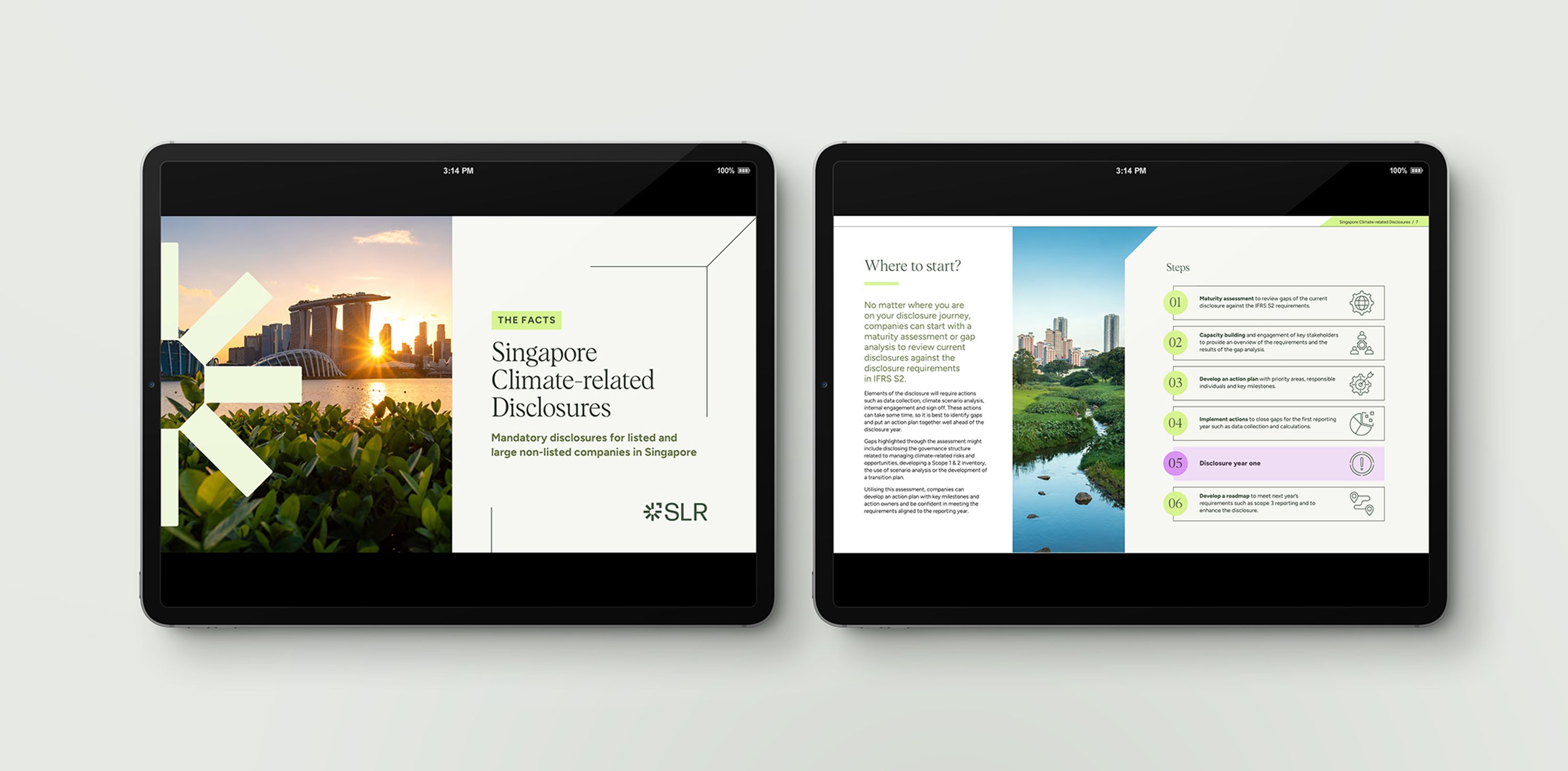
Whether you are an experienced reporter wondering what gaps you need to address to adhere to the new rules, or a company wondering where to start, we have produced a helpful factsheet.
For more information on how SLR can support you, please get in touch with us.