
SBTi Corporate Net-Zero Standard Version 2.0
by Jovontae Catline , Caroline Dolan, Joe Sarvary, Liz Whinnett
View post
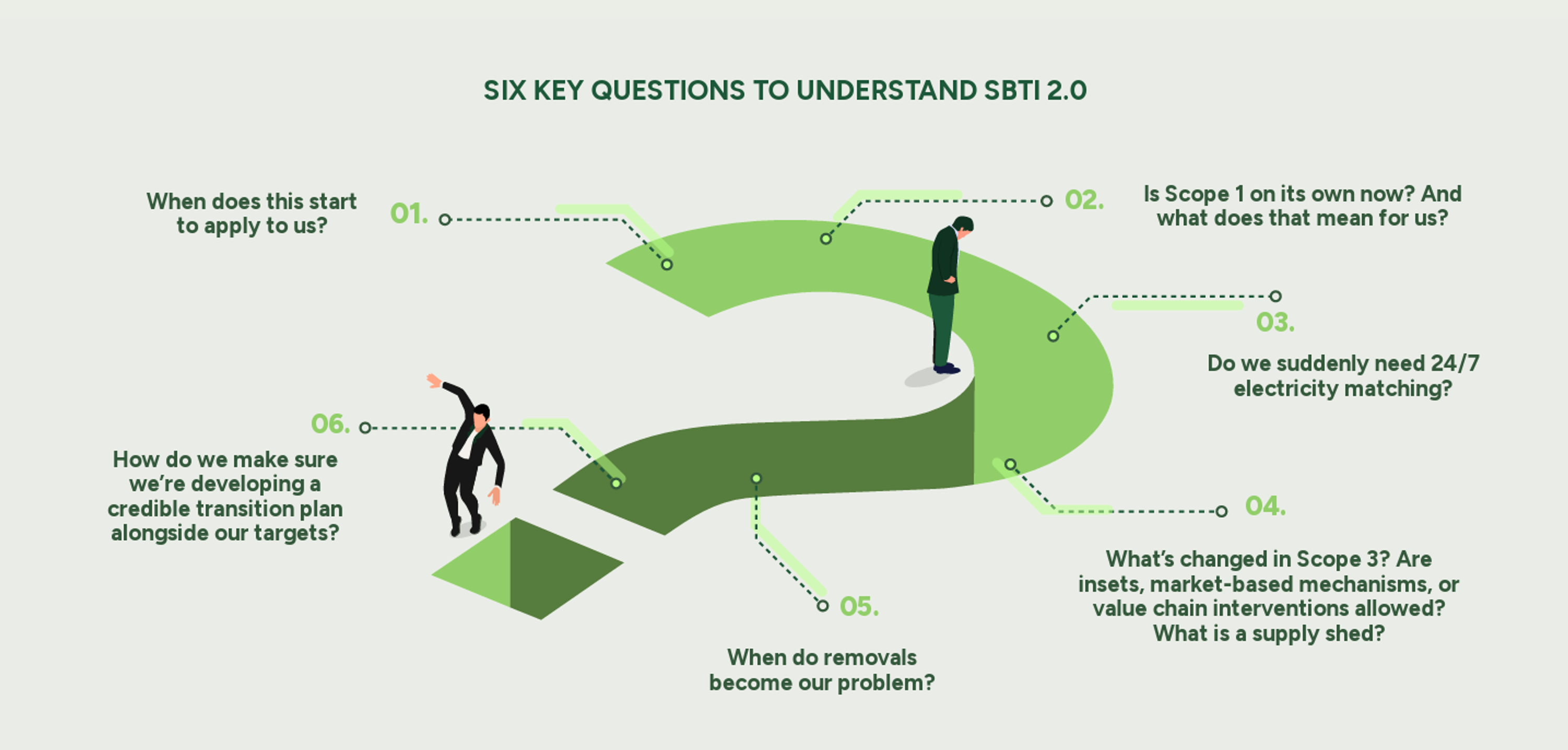
The new Corporate Net-Zero Standard has been published. If you're a CSO, CFO or sustainability lead, you've probably caught fragments of what it says, and you’re wondering what it means for you, without the time to read it cover to cover. Here's the short version. Below are the six key questions we're hearing most: the rumours you've likely heard, the truth of what really matters, and how you need to adapt your strategy as a result.
You've heard the new version is out, and you're wondering when the clock starts.
For most companies, later than you'd think. Your target runs on a cycle, typically reviewed around every five years from when you first set your target. V2.0 only bites when you set your next target. You can adopt it early from 1 February 2027, and it becomes required for new targets set from 31 January 2028. If your current target runs to 2028, 2029 or 2030, that's when this becomes real for you.
There's a sliver of optionality: re-baseline and reset your target before 31 January 2028 and you can keep working under the current version a little longer. Whether that's worth doing is debatable - for most, it simply defers the inevitable. The more valuable preparation is internal. These changes are going to have long-run impacts on your footprint, your targets, your decarbonisation plans and your climate transition strategy (including associated investments), so brief your internal stakeholders on what's coming.
This is particularly important given a new requirement to obtain internal approval at the highest level of governance to set and submit SBTi targets. Use the time before the next update to ensure the changes aren't a surprise to the people who hold the budget. Because, while the changes aren’t immediately activated, once you do roll into a V2.0 target, several things will change. We detail the most important changes in the rest of the article.
You've read that Scope 1 has been separated out from Scope 2 and both now require their own targets. This means that progress in electricity can no longer compensate for inaction on direct fuel consumption.
Until now, buying renewable electricity could hide slower progress on the fuel-consuming assets within your own operations. V2.0 eliminates that: Scope 1 will require a target of its own and will require incremental annual decarbonisation progress within a 5-year target period to remain credible. For almost every company, that means decarbonising fossil-fuelled long-life physical assets (think boilers and furnaces, etc.). In practice, this relies on major investments, process changes, energy efficiency, and alternative fuels. The technologies exist, but the cleaner options often carry a higher capital cost than the kit they replace.
That's why heat decarbonisation planning is one of the biggest implications of this new standard. In response, sustainability teams will need to build business cases for higher CAPEX assets that run more efficiently and/or on lower carbon fuels (including electricity).
Our recommendation is to dive into this asset replacement strategy by looking at the total-cost-of-ownership. The decisions you make on those assets don’t just impact the budget at the time of investment but have long running impacts on the OPEX based on which future fuel you begin to rely on. Because Scope 1 is considered on its own, companies will not be able to put off direct action any longer and will begin to make choices in the next few years which will shape their energy pathway for the next fifteen to twenty years.
You may have heard talk of "24/7" or hourly matching and wondered if it's now compulsory. Put simply: 24/7 sourcing is not a requirement, but 24/7 disclosure will be. You don't have to match your consumption to clean generation hour by hour, but if you're a large enough user, you will have to calculate and report how much of your electricity is matched to the hour of production at the end of your target cycle.
The first question you’ll be wondering is whether you consume enough for this to be material to you at all. The threshold is 10GWh per year per region. This means the onus will be on large electricity consumers such as manufacturers, data centres and heavy industry, the type of organisations who are likely being proactive with their carbon and energy management already. For those who do, this is a signal of where Scope 2 accounting is heading. V2.0 has come out ahead of the GHG Protocol's own revision of its Scope 2 Guidance, and we see this change as writing on the wall for what is to be expected in the evolutions we will see in wider carbon accounting.
The direction is clear: more granular, more local, more traceable. Demonstrating a high-integrity renewable sourcing strategy will increasingly depend on having the data systems to prove it, not just the contracts to claim it. Getting your site-level electricity data in order now is a practical no-regret step to prepare your teams for greater complexity in the future.
Scope 3 has become more flexible. This is the part that’s causing the biggest stir. V2.0 sets out several layers of Scope 3 actions deemed credible by SBTi. Acting directly at source is still the default. And where you can do it, you should. But for most companies, across the multi-tier, opaque and complex supply chains that define modern business, direct action simply isn't possible for much of your footprint yet.
So, the SBTi has now welcomed a hierarchy of actions: both within shared activity pools and at the sector level. This means interventions (at a lower hierarchical position to direct physical interventions) will be recognised if they’re undertaken at the level of shared electricity grids, logistics networks and supply sheds (defined as a group of suppliers providing similar commodities to a defined market). Purchasing certificates for low-carbon commodities produced within the company’s own supply shed would, for example, be one way of demonstrating action taken within shared activity pools. This whole framework is a breakthrough. It gives a recognised home to chain-of-custody models that enable the recognition of environmental claims in supply chains where physical tracking is challenging and certifies them (such as book-and-claim, mass balance, and insetting), an approach companies have wanted to use credibly for years, but haven’t had a standard to use to recognise it with integrity.
For our clients, this means a new suite of actions to demonstrate progress toward Scope 3 decarbonisation, with a hierarchy that prioritises direct action but now recognises market-based action where this is not yet possible. This framework is even more exciting if you sit in the middle of the value chain. If your emissions land in someone else's inventory as much as your own, then these changes provide an opportunity to commercialise the progress you’ve made in decarbonisation, share the cost of decarbonisation across the chain, and communicate the green attributes of what you sell. The opportunity is especially large for commodity manufacturers, including chemicals, cement and steel, as well as forest, land, and agricultural (FLAG) commodities. The SBTi is careful here to clarify the role of certificates / credits. V2.0 places the physical inventory (and direct action) at the top of the decarbonisation hierarchy, with targets being set against this baseline, recognising these additional market-based actions alongside and reported separately. However, the value of market-based instruments is being recognised along the pathway to net zero, and such actions are being encouraged with further guidance (from both SBTi and the Greenhouse Gas Protocol) to be released in the near future.
You've heard removals are coming for non-FLAG sector organisations. They are, and much sooner than you had previously planned. From 2035, large companies must use removals to cover a share of their ongoing residual emissions, starting at just 1% and rising in a straight line to 100% by their net zero year. That sounds gentle, but the ramp is steep: a company on a 2050 path is already required to remove roughly a third of its ongoing emissions by 2040, only five years in, and it climbs from there to full coverage. Sooner and steeper still if your net zero year is before 2050.
This removals ramp-up is impacting all of the largest SBTi committed companies. That means the market is going to experience a steep and steady rise in demand. Here's the problem: the market isn't ready for that. Durable removal capacity is scarce and slow to build. And because every large company moves to secure it on basically the exact same schedule, demand will outrun supply. Expect price volatility. The answer here isn't to wait, it's to plan early, with long-term procurement and a sourcing strategy built to ride out the swings rather than buy at the peak. As always, prevention is better than cure, so the obvious advice is to reduce emissions as much as possible to mitigate exposure.
For the first time, the SBTi is asking companies to develop a transition plan alongside their targets that sets out a roadmap for achieving their decarbonisation goals. This marks a shift away from the "set a target and report annually" approach seen previously, towards requiring a clear, visible and board-owned delivery plan behind every target.
For Category A companies (medium and large companies in higher-income countries), this plan must be published within 15 months of completing target validation. Beyond the details of the GHG reduction targets themselves, the SBTi is looking for two main things in a company’s transition plan:
The transition plan must also be formally approved by the Board of Directors (or equivalent), aligned or integrated into corporate strategy, and reviewed at least every five years. This is not an insignificant introduction by the SBTi. However, these requirements are relatively light touch compared with more comprehensive frameworks such as the gold standard Transition Plan Taskforce (TPT) [1] and those set out in CSRD. If you’ve already built, or are building, a plan aligned with these frameworks, you’re likely covered on SBTi’s transition planning components too.
Avoid developing a transition plan for disclosure’s sake. A transition plan built quickly to satisfy disclosure timelines will tick the SBTi box, but it won't do much else. In our experience, the real value of a transition plan is rarely the published plan; it’s the planning and implementation itself. The most effective transition planning processes help businesses identify what they can genuinely influence – across their own operations, value chains, and investment decisions. It can also reveal where there’s uncertainty and where progress depends on wider changes to markets, infrastructure, and policy - and what sensible responses and contingencies look like.
In our view, distinguishing between what's within your control and where you need to exercise influence or advocacy to shift the wider conditions is a critical step in building genuine credibility around your pathway to net zero.
V2.0 doesn't change your overarching goal: to decarbonise operations and the supply chain. What it changes is how you demonstrate progress towards this goal. It requires you to prove the real action taken across all your operations (particularly Scope 1) and offers new opportunities to demonstrate action on Scope 3. It also accepts that you won't travel in a perfectly straight line, making it simultaneously fairer and more demanding.
Many well-intended decarbonisation strategies stall once the low-hanging fruit (often carbon reductions through energy efficiency) has been fully harvested. However, the SBTi is now asking for more. Decarbonisation strategies now need to reflect comprehensive energy transition plans with coordinated action spread across a value chain, which can incorporate everything from complex on-site asset replacement plans through to the new Scope 3 certificates and sector-level interventions.
That's a real expansion of what's possible and a genuinely exciting moment for net zero strategies, low-carbon roadmaps, and the energy transition. SLR welcomes this evolution towards a more pragmatic, action-focused standard, and we look forward to further guidance as it is published. Our corporate sustainability and energy advisory experts are well placed to help CSOs, CFOs and sustainability teams navigate the evolving best practices and leverage compliance with SBTi V2.0 into practical actions for their operations and value chains.
Enjoyed this article? For more like it, get SLR's quarterly sustainable business briefing straight to your inbox.
Sign Up
The authors would like to thank James Balík-Meacher, Lorna Davies, Natalie Duncan, Kate Jones, Rose La Fay, Catalina Morales, Joseph Payne, Graeme Precious, Joe Woollett and everyone on SLR’s SBTi Experts Network who contributed to this article.
by Jovontae Catline , Caroline Dolan, Joe Sarvary, Liz Whinnett

by James Balik-Meacher, Sophia Davison, Miguel Oyarbide

by Selina Roman-White, Valeria Alvarado Tejeda, Madison Edson, James Van Horne, Craig Bock, Matthew Mitchell